.png)
SCIENTISTS CREATE WORLD’S FIRST UNIVERSAL KIDNEY COMPATIBLE WITH ALL BLOOD TYPES
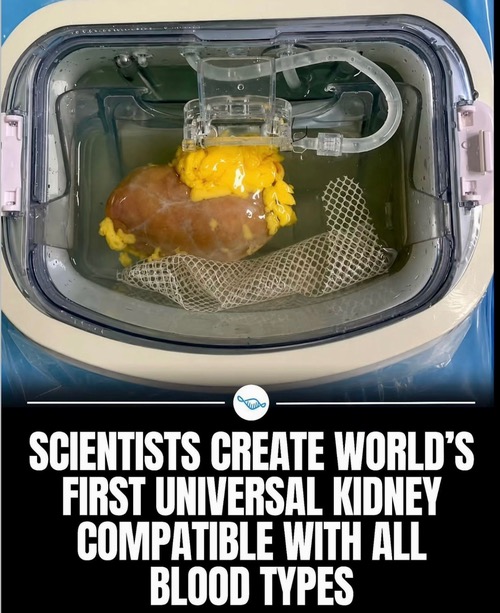
Scientists have developed a potential
"universal kidney" by converting a donor Type A kidney into a Type O-like organ, aiming to overcome blood type barriers in organ transplantation. Using specialized enzymes, researchers removed blood group antigens from the kidney surface, which normally trigger immune rejection between incompatible donors and recipients.
In a landmark proof-of-concept study, the modified kidney was transplanted into a brain-dead human recipient and functioned successfully for several days. The findings suggest that enzyme-based blood type conversion could expand the donor pool, shorten transplant waiting times, and improve access to life-saving organs. Researchers noted that some blood-type markers gradually reappeared, highlighting that additional development and testing are still needed.
If further validated, this technology could move transplantation medicine closer to creating organs that are compatible across multiple blood types, potentially helping address the global shortage of transplantable organs.
Zeng et al., Nature Biomedical Engineering - UBC enzyme technology study on blood type-converted kidneys:
core_biotechnology

_1.png)

comment